Introduction
With increasing mobility between the United States and Canada, many U.S. citizens and green card holders are actively considering a move to Canada or have already become Canadian tax residents. Canada offers an attractive lifestyle, a strong public infrastructure, and access to a wide range of registered savings plans. However, cross-border relocation also introduces significant tax complexity.
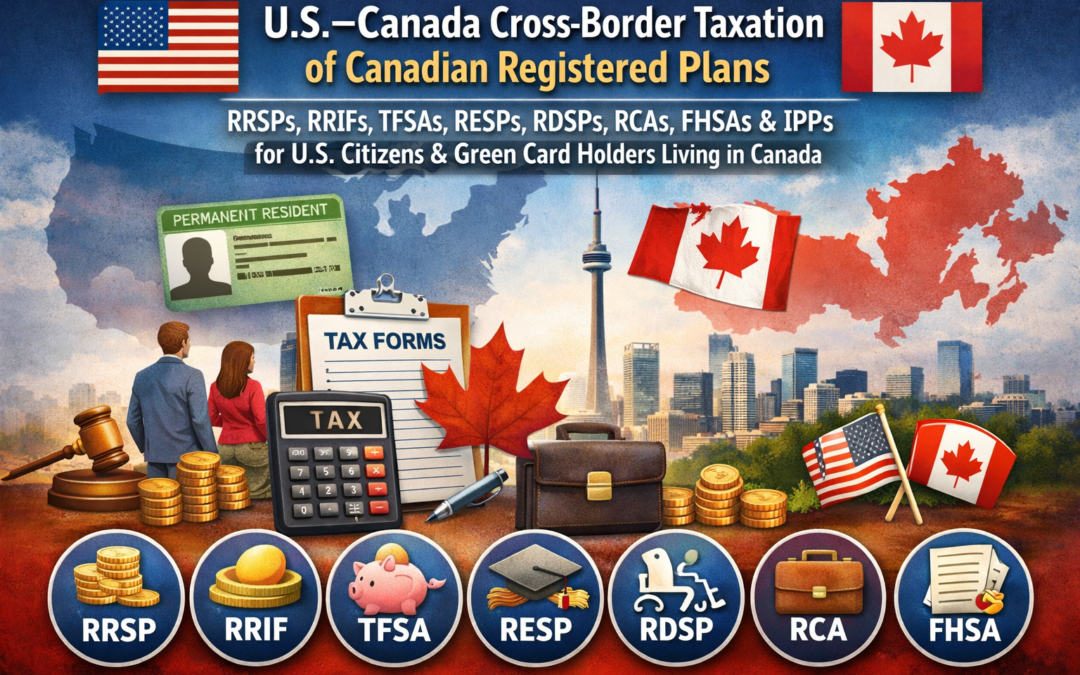
Importantly, U.S. citizens and green card holders remain subject to U.S. tax and reporting obligations even after establishing Canadian tax residency. As a result, many individuals face uncertainty when contributing to or withdrawing from Canadian registered plans. Accordingly, this article provides a comprehensive overview of the U.S.–Canada cross-border tax treatment of Canadian registered plans, including RRSPs, RRIFs, TFSAs, RESPs, RDSPs, RCAs, FHSAs, and IPPs. The discussion references the relevant provisions of the Canadian Income Tax Act (ITA), the U.S. Internal Revenue Code (IRC), and the Canada–U.S. Tax Treaty.
- RRSPs and RRIFs: The Most Treaty-Favored Canadian Plans
Canadian Tax Treatment
Under Canadian tax law, individuals may deduct contributions to a Registered Retirement Savings Plan (RRSP) under ITA section 146(5).
Investment income and capital gains grow on a tax-deferred basis. When withdrawals occur, Canada taxes them as ordinary income under ITA section 146(8).
Similar rules apply to Registered Retirement Income Funds (RRIFs) under ITA section 146.3.
U.S. Tax Treatment
By default, the United States taxes U.S. persons on worldwide income under IRC section 61. Therefore, absent relief, annual income and gains earned inside RRSPs and RRIFs would be taxable under the grantor trust rules in IRC sections 671-679.
However, Article XVIII(7) of the Canada–U.S. Tax Treaty allows U.S. citizens and residents to elect deferral of U.S. tax on undistributed RRSP and RRIF income until withdrawal. Consequently, U.S. taxation aligns with Canadian timing.
Although Form 8891 is obsolete, taxpayers now report RRSPs and RRIFs on Form 8938 (FATCA) and FinCEN Form 114 (FBAR). Importantly, when the treaty election applies, Forms 3520 and 3520-A are not required. Taxpayers make the election by reporting income only when distributions occur.
- TFSAs: Tax-Free in Canada but Fully Taxable in the U.S.
Canadian Tax Treatment
Canada allows individuals to contribute to a Tax-Free Savings Account (TFSA) without claiming a deduction. In return, all income and gains grow tax-free, and withdrawals remain exempt from Canadian tax under ITA section 146.2.
U.S. Tax Treatment
In contrast, the United States does not recognize the TFSA as a tax-exempt arrangement. As a result, U.S. persons must report TFSA income and gains annually under IRC section 61 and the grantor trust rules.
Moreover, the IRS generally treats TFSAs as foreign grantor trusts. Therefore, U.S. persons typically must file Form 3520 and Form 3520-A each year. FBAR and Form 8938 reporting also applies. Notably, no provision of the Canada–U.S. Tax Treaty provides deferral or exemption for TFSA income.
- RESPs and RDSPs: Partial Relief Through IRS Administrative Guidance
Canadian Tax Treatment
Contributions to Registered Education Savings Plans (RESPs) and Registered Disability Savings Plans (RDSPs) are not deductible in Canada.
Nevertheless, investment income and government grants grow on a tax-deferred basis.
Canada generally taxes withdrawals to the beneficiary when used for qualifying education or disability purposes under ITA sections 146.1 and 146.4.
U.S. Tax Treatment
From a U.S. perspective, these plans do not qualify for tax deferral. Therefore, U.S. persons must generally include annual income and gains under IRC section 61.
Historically, RESPs and RDSPs triggered Form 3520 and Form 3520-A reporting. However, IRS Revenue Procedure 2020-17 now exempts qualifying Canadian RESPs and RDSPs from these filings, provided specific conditions apply. That said, FBAR and Form 8938 reporting may still remain mandatory.
- RCAs: Specialized Executive Plans With Complex U.S. Treatment
Canadian Tax Treatment
Employers often use Retirement Compensation Arrangements (RCAs) to provide supplemental retirement benefits to high-income employees.
Canada does not tax employer contributions to the employee when made. Instead, the RCA trust pays a refundable tax equal to 50% of contributions and investment income under ITA section 207.5.
As benefits are paid, the refundable tax is recovered. At the same time, Canada taxes distributions to the employee as ordinary income under ITA section 56(1)(x).
U.S. Tax Treatment
For U.S. tax purposes, RCAs generally qualify as foreign nonexempt employees’ trusts under IRC section 402(b). If employer contributions occur while the individual is a U.S. nonresident, those contributions usually escape immediate U.S. taxation. However, distributions are taxable as ordinary income under IRC sections 72 and 402(b)(2).
Furthermore, highly compensated employees participating in non-broadly available plans may face annual income inclusion under IRC section 402(b)(4). In many cases, Forms 3520 and 3520-A may apply, although some practitioners argue for an exemption based on the plan’s classification.
- FHSAs: Attractive in Canada, Problematic for U.S. Persons
Canadian Tax Treatment
The First Home Savings Account (FHSA) allows individuals to deduct contributions under ITA section 146.6. In addition, income and gains grow tax-free. Canada does not tax qualifying withdrawals for a first home purchase. However, non-qualifying withdrawals remain taxable.
U.S. Tax Treatment and Compliance Risks
The United States does not recognize the FHSA’s tax-preferred status. U.S. persons must include income and gains annually under IRC section 61 and the grantor trust rules.
The FHSA may be classified as a foreign grantor trust, triggering Form 3520 and Form 3520-A filing requirements. FBAR and Form 8938 reporting also applies. The Canada–U.S. Tax Treaty does not provide deferral or exemption for FHSA income.
- IPPs: Employer Pensions With Limited Treaty Protection
Canadian Tax Treatment
An Individual Pension Plan (IPP) is an employer-sponsored defined benefit pension. Employer contributions are deductible under ITA section 147.1.
Investment income and gains accumulate on a tax-deferred basis, and pension payments are taxed as ordinary income.
U.S. Tax Treatment
From a U.S. perspective, IPPs generally qualify as foreign pension plans. Depending on structure, the IRS may treat an IPP as a foreign trust or a nonexempt employees’ trust under IRC section 402(b).
Unless treaty-based deferral applies, which remains uncommon for IPPs, U.S. persons may need to report annual income and gains. Accordingly, Forms 3520 and 3520-A often apply, in addition to FBAR and Form 8938 reporting.
- Key Takeaways for U.S. Citizens and Green Card Holders in Canada
Canadian registered plans provide meaningful benefits under Canadian tax law. However, most of those benefits do not carry over under U.S. tax rules. RRSPs and RRIFs benefit from explicit treaty protection, while other plans often create ongoing U.S. tax exposure and complex reporting obligations.
Therefore, U.S. citizens and green card holders living in Canada should review Canadian registered plans carefully before contributing or withdrawing. Coordinated cross-border tax planning helps reduce compliance risk, unexpected tax costs, and potential penalties.
Raj Pandher is a qualified CPA (cross border tax accountant), a Trust and Estate Practitioner (TEP) and a Certified Executor Advisor (CEA) who assists the U.S. citizens and green card holders immigrating from the U.S. to Canada with their U.S. Canada cross border income tax return(s) filing including foreign information return(s) reporting.