- Introduction
Why Entity Classification Matters After Immigration
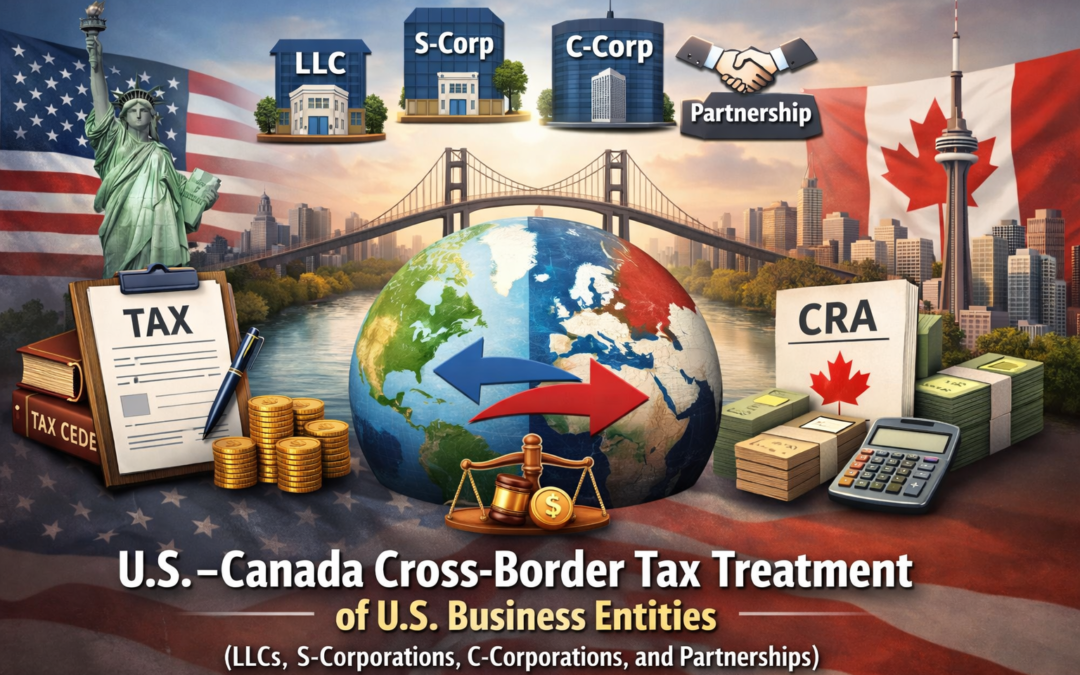
U.S. citizens and green card holders who become Canadian tax residents often continue to own U.S. business entities. These entities typically include LLCs, S-corporations, C-corporations, and partnerships. While these structures may operate efficiently under U.S. tax law, Canada applies different classification and timing rules. Consequently, mismatches frequently arise between U.S. and Canadian tax treatment.
These mismatches can trigger double taxation, denied foreign tax credits, and higher compliance costs when taxpayers do not plan carefully. Effective cross-border tax planning therefore requires a clear understanding of how each country classifies these entities, when income becomes taxable, and whether treaty relief applies.
- U.S. Limited Liability Companies (LLCs)
U.S. Tax Treatment of LLCs
Under IRC §7701 and the related Treasury Regulations, LLCs receive flexible tax treatment in the United States. A single-member LLC is treated as a disregarded entity unless it elects corporate status. A multi-member LLC is treated as a partnership unless it makes a corporate election. Income, deductions, and credits flow through to the members, who report them on their personal U.S. tax returns, typically on Form 1040 with Schedule E or through a Schedule K-1.
Canadian Tax Treatment of LLCs
Canada treats all LLCs as corporations, regardless of their U.S. tax classification. Canada does not recognize the U.S. flow-through nature of an LLC. Instead, Canada taxes a Canadian resident only when the LLC makes an actual distribution. Canada taxes these distributions as foreign dividends under ITA s. 90(1). Withholding tax under ITA s. 212 may also apply if the recipient is a nonresident.
Canada does not tax the LLC’s underlying income as it is earned. Canadian tax law does not permit look-through treatment for LLC income.
Timing Mismatches and Double Taxation Risk
LLCs present one of the highest risks of double taxation. The United States taxes the member on their share of LLC income as it is earned, even when no cash distribution occurs. Canada, by contrast, taxes only the dividend when paid. Because Canada taxes the dividend rather than the underlying income, it generally denies a foreign tax credit for U.S. tax paid at the member level. This mismatch in timing and classification often results in unrelieved double taxation.
Treaty Limitations for LLCs
The Canada–U.S. Tax Treaty generally does not provide relief for Canadian-resident U.S. citizens who invest through an LLC. The treaty does not treat an LLC as a U.S. resident unless the LLC itself is liable to U.S. tax. Although Article IV(6) provides limited relief for U.S. residents using fiscally transparent entities, this relief does not extend to U.S. citizens who are Canadian residents, based on the CRA’s published position.
- S-Corporations
U.S. Tax Treatment of S-Corporations
S-corporations operate as pass-through entities under IRC §§1361–1379. The corporation itself does not pay U.S. income tax. Instead, income, deductions, and credits flow through to shareholders. Shareholders report their allocated income annually on Form 1040, typically through Schedule E and Schedule K-1.
Canadian Tax Treatment of S-Corporations
Canada treats S-corporations as corporations rather than flow-through entities. Canada taxes a Canadian-resident shareholder only when the S-corporation makes a distribution. Canada taxes these distributions as foreign dividends under ITA s. 90(1). Withholding tax under ITA s. 212 may also apply.
Canada does not tax the shareholder on undistributed S-corporation income.
Timing Mismatch and Double Taxation Exposure
The United States taxes S-corporation income as it is earned, while Canada taxes only when the shareholder receives a dividend. This timing mismatch can prevent the shareholder from claiming a foreign tax credit for U.S. tax paid on undistributed income. As a result, S-corporation income can face effective double taxation.
Treaty Relief Through Article XXIX(5)
Article XXIX(5) of the Canada–U.S. Tax Treaty provides a critical planning opportunity. A U.S. citizen resident in Canada may request that the Canadian competent authority treat the S-corporation as a controlled foreign affiliate. If the authority approves the request, Canada treats the shareholder’s share of income as Foreign Accrual Property Income (FAPI) under ITA ss. 91 and 95. This treatment aligns income recognition timing and generally allows foreign tax credits, which significantly reduces double taxation.
- C-Corporations
U.S. Tax Treatment of C-Corporations
C-corporations are separate taxable entities under IRC §11. The corporation pays U.S. corporate income tax on its profits. Shareholders pay tax again when the corporation distributes dividends under IRC §301.
Canadian Tax Treatment of C-Corporations
Canada taxes dividends received by a Canadian resident from a U.S. C-corporation as foreign dividends under ITA s. 90(1). U.S. withholding tax applies to these dividends, but Article X of the Canada–U.S. Tax Treaty generally limits the withholding rate to 15%. Canada typically allows a foreign tax credit under ITA s. 126 for the U.S. withholding tax paid.
No Significant Timing Mismatch
Both countries tax shareholders when dividends are received. As a result, timing mismatches remain minimal. Foreign tax credits usually operate as intended, which makes C-corporations one of the more predictable structures for cross-border taxation.
- Partnerships
U.S. Tax Treatment of Partnerships
Partnerships operate as flow-through entities under IRC §701. The partnership itself does not pay U.S. income tax. Instead, partners report their share of income, deductions, and credits annually on their personal returns, typically through Schedule K-1.
Canadian Tax Treatment of Partnerships
Canada taxes Canadian-resident partners on their share of partnership income under ITA s. 96. Canada imposes this tax whether or not the partnership distributes cash. Because Canada taxes the same income as it is earned, foreign tax credits under ITA s. 126 are often available for U.S. tax paid.
Alignment of U.S. and Canadian Rules
Both Canada and the U.S. tax partnership income on a current basis. This alignment reduces timing issues and significantly lowers the risk of double taxation when compared to LLCs and S-corporations.
- Comparative Double Taxation Risk by Entity Type
LLCs and S-corporations present the highest risk of double taxation due to classification and timing mismatches. C-corporations and partnerships generally offer better alignment between U.S. and Canadian tax systems. S-corporation shareholders should strongly consider competent authority relief to reduce exposure.
- Cross-Border Reporting and Compliance Requirements
Canadian residents with interests in U.S. entities must meet extensive reporting requirements. These obligations commonly include Form T1135 for specified foreign property and Form T1134 for foreign affiliates. U.S. citizens and green card holders must also continue filing U.S. tax returns, including Forms 1040, 1065, 1120, 1120S, and the related Schedule K-1 filings.
Failure to comply can trigger significant penalties in both countries.
- Practical Planning Considerations and Key Takeaways
Structuring Considerations After Immigration
Entity choice and income timing matter significantly after immigration to Canada. Taxpayers should generally avoid holding LLC interests as Canadian residents when possible. In some cases, dissolving a single-member LLC or converting it to a partnership before immigration may reduce long-term tax exposure. S-corporation shareholders should evaluate whether Article XXIX(5) relief is available. C-corporations and partnerships typically allow more straightforward foreign tax credit planning.
Final Observations
U.S. citizens and green card holders who become Canadian tax residents must carefully review their ownership of U.S. business entities. Proper planning can reduce double taxation, ensure compliance, and preserve after-tax returns. Entity classification, income timing, and treaty relief remain central to effective U.S.–Canada cross-border tax planning.
Raj Pandher is a qualified CPA (cross border tax accountant), a Trust and Estate Practitioner (TEP) and a Certified Executor Advisor (CEA) who assists the U.S. citizens and green card holders immigrating from the U.S. to Canada with their U.S. Canada cross border income tax return(s) filing including foreign information return(s) reporting.