
Introduction
The tax landscape for U.S. citizens living abroad changed significantly on August 31, 2026. On that date, the U.S. Court of Appeals for the Federal Circuit issued two important decisions: Estate of Paul Bruyea v. United States and Christensen v. United States.
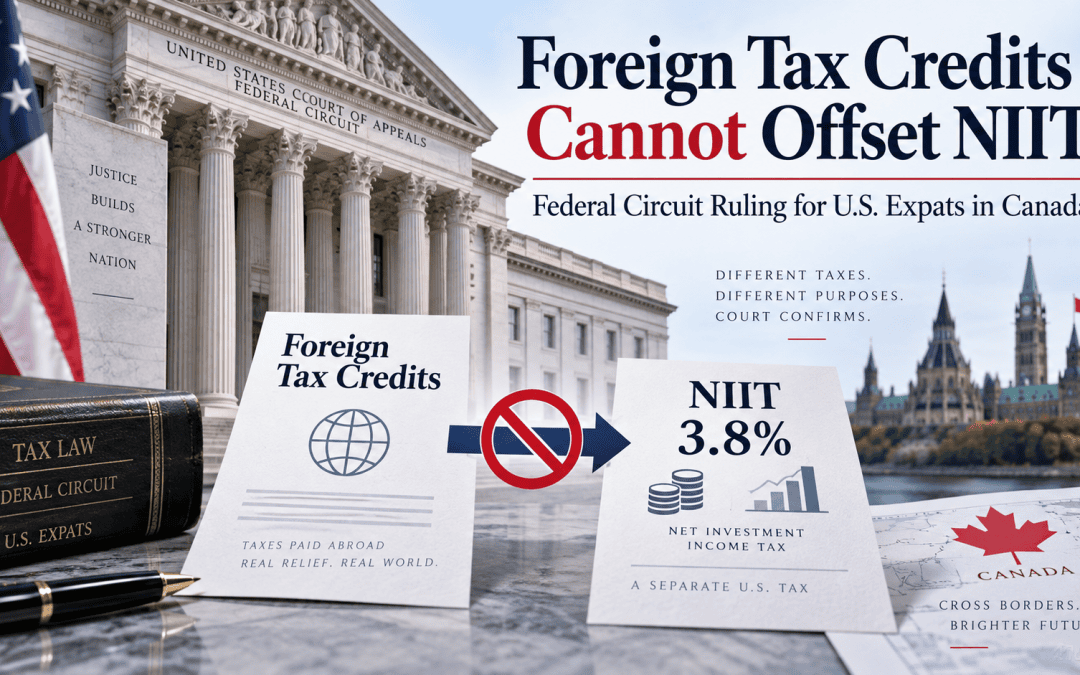
The Federal Circuit held that taxpayers cannot use foreign tax credits (FTCs) under the U.S.-Canada or U.S.-France tax treaties to offset the 3.8% Net Investment Income Tax (NIIT) under IRC § 1411.
As a result, these decisions reverse earlier taxpayer-favorable rulings from the Court of Federal Claims. They also strengthen the IRS position that NIIT remains separate from taxes that taxpayers can generally offset with foreign tax credits.
What Is the Net Investment Income Tax?
IRC § 1411 imposes a 3.8% Net Investment Income Tax on certain individuals whose modified adjusted gross income exceeds statutory thresholds.
The threshold is generally:
- $250,000 for married taxpayers filing jointly; and
- $200,000 for single taxpayers.
Net investment income commonly includes interest, dividends, annuities, royalties, rents, and capital gains.
For U.S. citizens living abroad, this tax can create double taxation. For example, Canada may tax the same investment income that the United States subjects to NIIT.
Therefore, the treatment of foreign tax credits against NIIT has significant consequences for U.S. citizens living in Canada.
Can Foreign Tax Credits Offset NIIT?
The Federal Circuit says no.
Taxpayers argued that the U.S.-Canada and U.S.-France tax treaties created an independent right to claim foreign tax credits against NIIT. In particular, they relied on treaty provisions designed to prevent double taxation.
However, the Federal Circuit rejected that argument. The court concluded that U.S. domestic law limits the foreign tax credit and prevents taxpayers from applying it against NIIT.
Why Can’t Foreign Tax Credits Offset NIIT?
The Federal Circuit focused heavily on the structure of the Internal Revenue Code. In particular, the court examined where Congress placed the foreign tax credit provisions and the NIIT.
Foreign Tax Credits Apply to Chapter 1 Taxes
IRC §§ 27 and 901(a) generally allow foreign tax credits against taxes imposed under Chapter 1 of the Internal Revenue Code. Chapter 1 includes the regular federal income tax and related surtaxes.
Therefore, the foreign tax credit generally applies only within that statutory framework.
NIIT Falls Under Chapter 2A
By contrast, Congress placed the Net Investment Income Tax in IRC § 1411 under Chapter 2A, titled “Unearned Income Medicare Contribution.” Because NIIT falls under Chapter 2A rather than Chapter 1, the court concluded that IRC § 901 does not allow taxpayers to offset NIIT with foreign tax credits.
In other words, the location of the NIIT within the Code matters.
IRC § 26(b) Further Limits the Credit
The court also considered IRC § 26(b), which defines regular tax liability and identifies taxes that do not qualify as Chapter 1 taxes for these purposes. Together, IRC §§ 26, 27, and 901 create a statutory framework that limits foreign tax credits to qualifying Chapter 1 taxes.
As a result, the Federal Circuit viewed Congress’s placement of NIIT in Chapter 2A as significant. In the court’s view, that structure prevents taxpayers from using an FTC to reduce NIIT.
Does the U.S.-Canada Tax Treaty Allow an FTC Against NIIT?
The taxpayers argued that the U.S.-Canada Income Tax Treaty independently required relief from double taxation. However, the Federal Circuit disagreed.
Article XXIV(1) of the U.S.-Canada treaty provides relief from double taxation “in accordance with the provisions and subject to the limitations of the law of the United States.”
That language became central to the court’s decision.
How Does the U.S. Law Limitation Affect NIIT?
The Federal Circuit treated this treaty language as a “U.S. Law Limitation.” Therefore, the treaty does not create an unlimited foreign tax credit. Instead, it subjects the credit to restrictions already found in U.S. tax law.
Because IRC § 901 limits foreign tax credits to Chapter 1 taxes, the court held that the treaty could not extend the credit to Chapter 2A NIIT.
Why Did the Court Review the Treaty Re-Sourcing Rules?
The court also examined the re-sourcing provisions in Article XXIV(3) and (6) of the U.S.-Canada treaty. These provisions can treat certain U.S.-source income as Canadian-source income. As a result, they can help taxpayers overcome the source limitation under IRC § 904.
The Federal Circuit reasoned that these rules would have little purpose if the treaty created a completely independent foreign tax credit. Therefore, the court viewed the re-sourcing provisions as further evidence that treaty-based credits still operate within the Internal Revenue Code.
What Happened in Estate of Bruyea v. United States?
Paul Bruyea was a U.S. citizen who lived in British Columbia. In 2015, he sold Canadian real estate and paid Canadian income tax on the resulting gain. However, the United States also imposed approximately $263,523 of NIIT on the transaction.
Bruyea’s estate argued that Article XXIV of the U.S.-Canada treaty required the United States to provide a foreign tax credit against NIIT.
Initially, the Court of Federal Claims agreed.
The Federal Circuit, however, reversed that decision. The court held that Article XXIV remained subject to the limitations of U.S. law. Since the Internal Revenue Code does not allow foreign tax credits against Chapter 2A NIIT, the treaty did not create an additional credit.
What Happened in Christensen v. United States?
The Christensen case involved U.S. citizens who lived in France. The taxpayers sold shares in a French company and paid French tax on the resulting capital gain. In addition, the United States taxed the gain and imposed NIIT.
The Christensens argued that Article 24 of the U.S.-France tax treaty provided an independent foreign tax credit against NIIT.
Again, the Federal Circuit rejected that position.
The court held that the treaty credit remained subject to the limitations in IRC §§ 27 and 901(a). Consequently, the taxpayers could not use their French taxes to offset NIIT.
What Do the NIIT Decisions Mean for U.S. Expats in Canada?
The Bruyea and Christensen decisions have important consequences for U.S. citizens living in Canada and other treaty countries.
Foreign Tax Credits Generally Cannot Offset NIIT
U.S. citizens living in Canada may pay Canadian tax and U.S. NIIT on the same investment income.
However, under the Federal Circuit’s decisions, they generally cannot use Canadian foreign tax credits to eliminate the NIIT.
As a result, the 3.8% NIIT may become a real additional tax cost for U.S. citizens living in Canada.
Protective NIIT Refund Claims Face Greater Difficulty
Some taxpayers filed protective refund claims while the Bruyea and Christensen litigation remained unresolved.
Now, however, the Federal Circuit’s decisions substantially weaken those claims.
The IRS has strong appellate authority supporting its position that treaty-based foreign tax credits cannot offset NIIT. Therefore, taxpayers with pending claims should review their position with a qualified cross-border tax advisor.
Treaty-Based NIIT Positions May Require Form 8833
Taxpayers who continue to take a treaty-based position may need to disclose that position on Form 8833, Treaty-Based Return Position Disclosure Under Section 6114 or 7701(b).
However, the Federal Circuit’s decisions make such an FTC claim against NIIT much more difficult to defend.
The Decisions Create Greater Consistency Across Courts
The Federal Circuit’s conclusions align with other cases that rejected foreign tax credits against NIIT.
For example, these include Toulouse v. Commissioner and Kim v. United States.
Consequently, the growing consistency among courts makes a successful challenge to the IRS position more difficult.
Can U.S. Expats Still Avoid Double Taxation?
Yes, in many situations. The U.S.-Canada tax treaty and foreign tax credit rules still provide important protection from double taxation.
However, the Federal Circuit has confirmed a significant limitation. Those protections generally do not allow taxpayers to use Canadian income taxes to offset the 3.8% NIIT.
Therefore, U.S. citizens with substantial investment income should account for NIIT when planning investments, asset sales, and other taxable transactions.
Which Transactions May Trigger NIIT for U.S. Expats?
U.S. citizens living in Canada should pay particular attention to transactions that generate significant investment income.
For example, these may include:
- sales of Canadian real estate;
- sales of corporate shares;
- large capital gains;
- dividends and interest;
- rental income; and
- other investments that may generate NIIT.
In addition, taxpayers who previously claimed a foreign tax credit against NIIT should consider reviewing those returns.
Taxpayers with pending protective refund claims should also review how the Bruyea and Christensen decisions affect their position.
What Should U.S. Citizens in Canada Do Now?
U.S. citizens in Canada should review their investment income and determine whether NIIT applies.
In particular, taxpayers with large capital gains or investment transactions should consider the 3.8% NIIT when estimating their U.S. tax liability.
Additionally, taxpayers who previously relied on treaty-based foreign tax credits against NIIT should review those filings with a U.S.-Canada cross-border tax advisor.
Finally, taxpayers planning future asset sales should consider NIIT before completing a transaction rather than addressing the tax only after the fact.
Conclusion: NIIT Remains a Cost for Many U.S. Expats
The Federal Circuit has confirmed that foreign tax credits generally cannot offset the 3.8% Net Investment Income Tax.
Therefore, U.S. citizens living in Canada may face Canadian tax and U.S. NIIT on the same investment income.
The U.S.-Canada tax treaty still provides substantial protection against double taxation. However, NIIT now represents an important exception.
As a result, U.S. citizens in Canada with significant investment income should consider NIIT when reviewing prior returns, calculating estimated taxes, and planning future investments or asset sales.
Raj Pandher is a qualified CPA (cross border tax accountant), a Trust and Estate Practitioner (TEP) and a Certified Executor Advisor (CEA) who assists the U.S. citizens and green card holders immigrating from the U.S. to Canada with their U.S. Canada cross border income tax return(s) filing including foreign information return(s) reporting.