Introduction
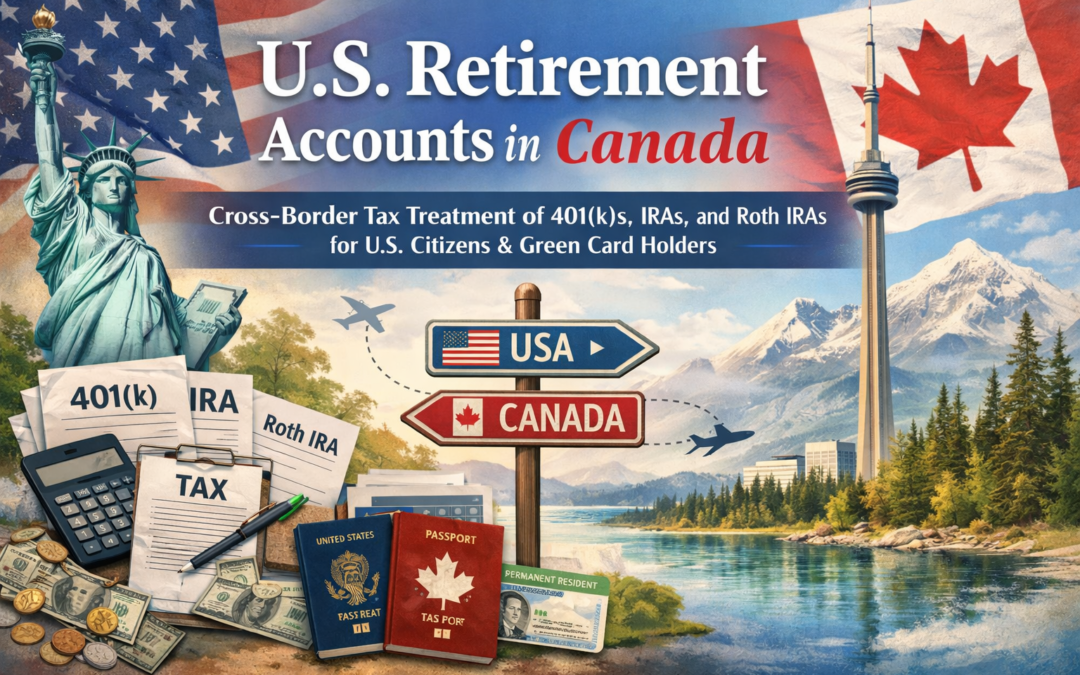
Cross-border mobility between the United States and Canada continues to increase. As a result, many U.S. citizens and green card holders either plan to move to Canada or have already become Canadian tax residents. Many of these individuals continue to hold U.S. retirement accounts.
Common U.S. retirement plans include 401(k)s, 403(b)s, Traditional IRAs, Roth IRAs, and inherited IRAs. These accounts often remain in the United States after immigration. However, Canadian tax residency can significantly change how these plans are taxed and reported.
Differences between U.S. tax law, Canadian income tax rules, and the Canada–U.S. Income Tax Treaty can create unexpected tax exposure. They can also trigger additional reporting obligations and double taxation.
This article explains how U.S. retirement accounts are taxed in both countries and ongoing cross-border tax compliance.
- U.S. Tax Treatment of Retirement Account Contributions and Distributions
401(k) and 403(b) Plans — U.S. Tax Treatment
Under Internal Revenue Code (IRC) sections 401(a), 403(b), and 72, distributions from 401(k) and 403(b) plans are included in gross income and taxed as ordinary income.
Taxpayers who withdraw funds before age 59½ may face a 10% early-distribution penalty. Certain statutory exceptions can eliminate this penalty.
Traditional IRAs — U.S. Tax Treatment
IRC section 408(d) taxes the distributions from Traditional IRAs as ordinary income. Early withdrawals may also attract a 10% penalty unless an exception applies.
These U.S. tax rules apply regardless of the account holder’s country of residence.
- Canadian Tax Treatment of U.S. Retirement Accounts
General Canadian Tax Rule
For Canadian tax residents, distributions from U.S. retirement accounts are generally included in income as superannuation or pension benefits under paragraph 56(1)(a) of the Income Tax Act (ITA).
Treaty Limitation on Taxable Amount (Article XVIII(1))
Article XVIII(1) of the Canada–U.S. Income Tax Treaty limits the amount taxable in Canada to the amount that would be taxable in the United States if the individual were a U.S. resident. As a result, amounts that would be excluded from U.S. taxation—such as a return of after-tax contributions—are also excluded from Canadian taxation.
Lump-Sum Distributions
Certain lump-sum distributions may qualify for a deduction under ITA subparagraph 110(1)(f)(i). This deduction applies when treaty provisions exempt the amount from U.S. taxation.
- Role of the Canada–U.S. Income Tax Treaty (Article XVIII)
One of the most critical planning tools for Canadian residents holding U.S. retirement accounts is the Article XVIII(7) election:
Purpose of the Election
Article XVIII(7) allows Canadian residents to defer Canadian taxation on income and gains accruing inside eligible U.S. retirement plans. Taxation occurs only when the individual receives distributions.
Conditions for the Election
The retirement plan must qualify as tax-exempt in the United States. It must also operate exclusively to provide pension or employee benefits.
Taxpayers usually make the election once. They do so by attaching a written statement to their Canadian income tax return and filing it with the Canada Revenue Agency.
Effect of the Election
Without the election, Canada may tax annual income inside the plan on a current basis. With the election in place, Canadian defers taxation until distribution. This alignment improves the effectiveness of foreign tax credits.
- Special Considerations for Roth IRAs and Roth 401(k) Accounts
U.S. Tax Treatment of Roth Accounts
Qualified distributions from Roth IRAs and Roth 401(k) plans are tax-free in the United States. The account holder must satisfy the five-year holding period and be at least age 59½.
Canadian Tax Treatment and Treaty Recognition
The 2007 Protocol to the Canada–U.S. Tax Treaty clarified the Roth IRA treatment. The treaty treats a Roth IRA as a “pension” if the account holder makes no contributions after becoming a Canadian resident.
When a distribution qualifies as tax-free in the U.S., Canada also exempts it from tax under Article XVIII(1).
Article XVIII(7) Election for Roth IRAs
Canadian residents may make an Article XVIII(7) election for Roth IRAs. The election defers Canadian tax on undistributed income. However, any post-residency contributions if made invalidates the election.
Contributions After Canadian Residency
If a Canadian resident contributes to a Roth IRA or Roth 401(k) after becoming resident in Canada:
- The account ceases to qualify as a pension under the treaty
- Future growth and distributions attributable to post-residency contributions become taxable in Canada
- Any prior Article XVIII(7) election may be invalidated
- Inherited U.S. Retirement Accounts and Canadian Tax Issues
U.S. Tax Treatment — SECURE Act 10-Year Rule
The SECURE Act applies to most non-spouse beneficiaries of IRAs inherited after 2019. These beneficiaries must withdraw the entire balance from the account by December 31 of the tenth year following death.
Although the law does not require annual required minimum distributions, beneficiaries must withdraw the entire balance by the end of year ten. Starting in 2025, certain beneficiaries will be required to take annual withdrawals within the 10-year period; failure to do so may result in penalties for missed required minimum distributions (RMDs).
Spouse beneficiaries may roll the IRA into their own account or follow standard RMD rules.
Certain eligible designated beneficiaries—including minor children (until majority), disabled or chronically ill individuals, and beneficiaries close in age to the decedent—may still use stretch-style withdrawals.
Canadian Tax Treatment of Inherited IRAs
For Canadian residents, inherited U.S. IRAs are treated unfavorably from a tax perspective:
- Taxable as Pension Income: Canada taxes inherited U.S. IRA distributions as pension income under ITA paragraph 56(1)(a), regardless of whether the beneficiary is a spouse or non-spouse.
- No Step-Up in Basis: Canada does not recognize a step-up in basis for inherited IRAs; the full distribution is taxable.
- Foreign Tax Credits: Beneficiaries may claim foreign tax credits for U.S. withholding tax on distributions, subject to subject to limitations and potential timing mismatches.
- Treaty Limits on Withholding: Article XVIII(2) limits U.S. withholding tax to 15% on periodic pension payments (and generally 25% on lump-sum withdrawals
Impact of the 10-Year Rule in Canada
Accelerated withdrawals can push beneficiaries into higher marginal tax brackets, reducing the effectiveness of foreign tax credits—particularly if distributions are delayed until year ten.
- Ongoing Compliance and Reporting Requirements
United States Reporting
- Form 1099-R
- Form 1040
- FBAR and FATCA filings, where applicable
Canadian Reporting
- T1 income tax return reporting foreign pension income
- Foreign tax credits claimed using Forms T2209 (federal) and T2036 (provincial/territorial)
- Form T1135 where applicable: If the cost amount of a Roth IRA exceeds C$100,000, it must be reported on Form T1135 (Foreign Income Verification Statement). If an Article XVIII(7) election is made and no Canadian contributions have been made, the CRA does not require reporting on T1135, T1141, or T1134. If no election is made or a Canadian contribution occurs, reporting is required.
If you are a U.S. citizen or green card holder living in Canada—or planning a move—professional cross-border tax planning is essential before making retirement account withdrawals or restructuring your financial affairs.
Proper planning can preserve tax-deferred growth, reduce double taxation, and ensure compliance with both U.S. and Canadian tax authorities.
Contact a qualified U.S.–Canada cross-border tax accountant to review your retirement accounts and develop a coordinated strategy tailored to your residency and long-term goals
Raj Pandher is a qualified Chartered Professional Accountant (CPA), CPA (cross border tax accountant), a Trust and Estate Practitioner (TEP) and a Certified Executor Advisor (CEA) who assists the U.S. citizens and green card holders immigrating from the U.S. to Canada with their U.S. Canada cross border income tax return(s) filing including foreign information return(s) reporting.